Every floating home guide on the internet tells you the same thing before you've even scheduled a showing. Standard mortgages don't apply. Budget for a chattel loan or a marine lender. Expect a higher rate, a bigger down payment, and a smaller pool of banks willing to touch the deal. It's good advice, and it's wrong for the one dock in Fremont where you're most likely to be shopping.
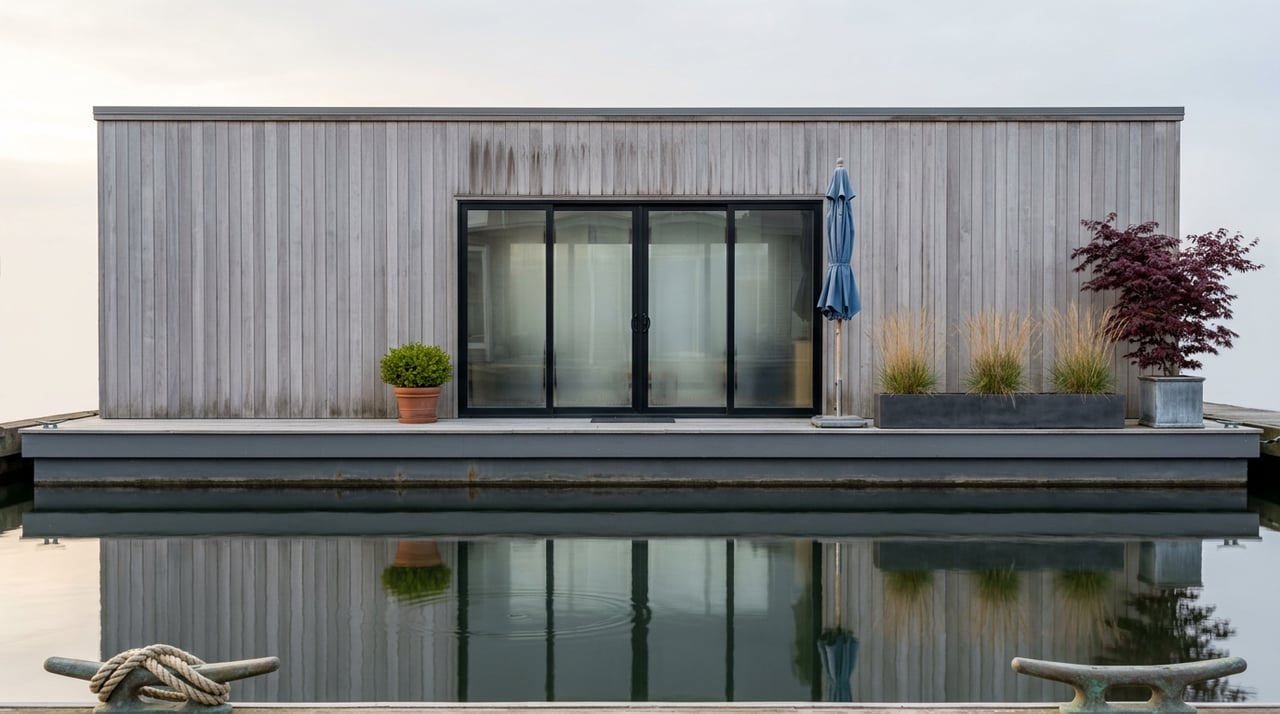
Lee's Mooring sits at 933 North Northlake Way, and it is Fremont's only floating home dock. The dock's history is a little tangled depending on which account you read. An interview with current owners, published by a Pacific Northwest window and door company that photographed one of the homes, traces the community back to the 1930s, when Ed and Alice Lee lived on the water and rented out additional houseboats to neighbors. Other guides to the dock date its formal establishment to 1990, which is more likely when the community took its current legal form as a condominium. Either way, that condo structure is what matters for anyone shopping here now. Condo not co-op, condo not leased moorage, is the reason the financing warning you've read three times doesn't hold up at this dock.
Owned Slip Versus Leased Slip Is the Whole Ballgame
Across Lake Union, the single biggest driver of a floating home's financing path is whether the slip underneath it is owned or leased. King County's own assessor documentation draws this line clearly: in a condominium or cooperative structure, the owner holds a share of real property along with the home. In a non-owned moorage arrangement, the floating home itself is personal property, and the dock owner controls the slip. That distinction is why some floating homes qualify for a conventional or FHA loan and others need a specialty marine loan with shorter terms and steeper rates.
Lee's Mooring is condo-owned. Every unit on that dock carries a real property interest in the slip alongside the home. That's why a Fremont buyer looking at this specific dock is working with a purchase that behaves, for financing purposes, much closer to a land-based condo than to the chattel-loan scenario the generic guides warn about. The paperwork you'll actually wrestle with isn't a marine underwriter. It's a condo resale certificate.
What a Condo Buyer Already Knows, Applied to Water
Because Lee's Mooring is legally a condominium, Washington's condominium law requires the seller to provide a resale certificate before closing, the same document that trips up buyers of any older Seattle condo building. That certificate discloses whether a special assessment is currently in place, the state of the reserve fund, and the governing documents that bind every owner on the dock. A 15-unit floating home condo has fewer components to fund than a mid-rise building, but it still has one asset that dwarfs anything a land-based condo board manages: the dock itself, plus the pilings, utility hookups, and shared marina.
If you're used to shopping land-based condos in Capitol Hill or Belltown, you already know to ask for the reserve study and read the special assessment line before you fall in love with a unit. Bring that same habit to Lee's Mooring. Don't assume the "it's basically a boat" framing means the paperwork is looser. It means the paperwork is different, and it still needs the same read.
The Friction Nobody Warns You About: Parking and the Dive Inspection
If financing isn't where a Lee's Mooring buyer gets surprised, two other things are.
The first is parking. Deeded garage spots are rare on Lake Union, and Lee's Mooring is one of only three floating home docks on the entire lake that has them. A unit with a deeded garage spot and a second part-time spot for evenings and weekends is a meaningfully different asset than one without, and that difference shows up in price and in how fast a listing moves. If you're comparing two units at the dock, ask specifically what parking is deeded to the unit versus what's available on the street.
The second is the inspection stack. A standard home inspection here runs $300 to $600, which is normal. What isn't normal is the second inspection almost every lender will require before funding: a dive inspection of the float itself, typically another $400 to $600. You're not just paying someone to check the roof and the water heater. You're paying a diver to confirm the concrete or log float underneath the house is sound, because a failed float is not a repair you can defer the way you'd defer a roof.
What the Numbers at This Dock Actually Show
Public listing records give a narrow but useful window into pricing at Lee's Mooring. A unit there sold for $1,400,000 in 2021 at 1,539 square feet, or roughly $910 a square foot. A different unit at the same dock is on the market now for $1,850,000 at 1,500 square feet, closer to $1,230 a square foot. That's a real jump in price per square foot over five years, though with only 15 homes on the dock, any single sale moves the average more than it would in a larger condo building. Treat any per-square-foot figure at Lee's Mooring as a starting point for negotiation, not a settled number.
Whatever premium you're paying to live on the water at Lee's Mooring, weigh it against what that same money buys a few blocks up the hill in land-based Fremont. A floating home's price per square foot at this dock runs well above a typical Fremont condo or townhome, and that gap is the real cost of the moorage and the view, not something a comps sheet pulled from an inland listing will show you.
Other Fremont-area floating homes have listed well above what Lee's Mooring typically sees. One listed for $5.8 million with a basement, a feature no longer permitted in new floating home construction, according to the listing broker who spoke to Fox 13 Seattle about the shoreline's environmental restrictions. Another Fremont floating home, designed with input from Seattle architecture firm Graham Baba, listed for $6.2 million and made local news for its built-in diving board. Those are outliers, not comps for Lee's Mooring's owner-occupied, condo-structured units, but they show how wide Fremont's floating home price range actually runs.
What This Means If You're Comparing Docks
If you're cross-shopping Lee's Mooring against a leased-moorage houseboat elsewhere on the lake, run the comparison on total cost of ownership, not sticker price. A leased slip might list lower, but factor in the chattel loan's shorter term and higher rate, the marine lender's smaller pool of willing banks, and the possibility that liveaboard status at a leased marina can be revoked by the landlord. An owned slip at Lee's Mooring costs more up front and finances more like a home you already know how to buy.
If you're deciding between Lee's Mooring and a land-based Fremont condo or townhome, the honest comparison is square footage per dollar plus what you're actually buying with the premium: direct water access, a 15-home community with its own governance, and proximity to Fremont's restaurants and shops without a commute across a bridge.
FAQ
Is a floating home at Lee's Mooring considered real estate or personal property for tax purposes? Because the dock is condominium owned, the home and its slip share are treated as real property, unlike floating homes on non-owned moorage, which King County assesses as personal property separate from the land beneath them.
Can I get a conventional mortgage on a Lee's Mooring floating home? Because the slip is owned rather than leased, these units are far more likely to qualify for conventional or FHA financing than floating homes on leased moorage, though individual lender requirements still vary.
Do I need a diver in addition to a home inspector? Yes. Most lenders require a separate dive inspection of the float, typically $400 to $600, on top of a standard home inspection.
How many floating homes are actually on this dock? Lee's Mooring has 15 floating home units, which is part of why any single recent sale can swing the per-square-foot average more than it would in a larger building.
If you're comparing a floating home at Lee's Mooring against options elsewhere in Fremont or across Lake Union, Zac Lee can walk through the resale certificate, the financing path, and what a specific unit's parking and moorage rights are actually worth before you write an offer. Get your free home valuation to see where your current property stands before you make the move.