
Seattle buyers can make their mortgage budget go further by comparing complete loan offers, reviewing what could improve their loan terms, and weighing seller credits against a price reduction. The goal is a monthly payment you can comfortably carry, with enough cash left for life after closing.
A half-point difference in your mortgage rate can have a noticeable effect. On a $680,000, 30-year fixed mortgage, the difference between 7% and 6.5% is about $226 a month in principal and interest, or about $2,712 a year. These are illustrative rates, not current loan quotes.
There’s also a local reason to compare your options. King County had 31.1% more active listings in September 2026 than a year earlier, according to NWMLS. More choices can give buyers room to compare properties and negotiate, although that varies by neighborhood, property type, and the individual seller.
Review credit and income while protecting cash reserves
Your credit history affects the mortgage options and pricing available to you. Rather than trying to improve your score without a plan, ask your lender what would actually make a difference for your application.
If you work in tech and part of your compensation comes through bonuses or restricted stock units, ask the lender to review that income early. Team Petros highlights vesting history, current awards, and the likelihood of continuing compensation as part of that review. Whether the income can be used depends on the loan program and documentation; don’t assume every dollar will count.
Would paying down a particular balance help? Is there an error on your credit report to correct? Would putting more money down improve the loan terms enough to justify keeping less cash in reserve?
Have that conversation before opening new credit, financing a car, or moving a large amount of cash. The right next step depends on your finances and how soon you plan to buy.
For a Seattle buyer, those reserves matter. An older house may need repairs soon after closing. A condo may come with HOA obligations that need closer review. Keeping enough cash for the property you’re buying should be part of the financing discussion.
Compare mortgage offers using the same assumptions
A low advertised rate doesn’t tell you what it costs to get that rate. Some quotes include discount points, which mean paying more at closing in exchange for a lower interest rate.
Ask lenders to compare the same loan amount, loan type, term, and rate-lock period. Request quotes close together in time, and make the points or lender credits explicit. Once you have a property identified, use Loan Estimates to compare the payment, lender fees, points, mortgage insurance, and cash required to close.
Here’s what different rates look like on an illustrative $850,000 purchase with 20% down: a $680,000 loan repaid over 30 years.
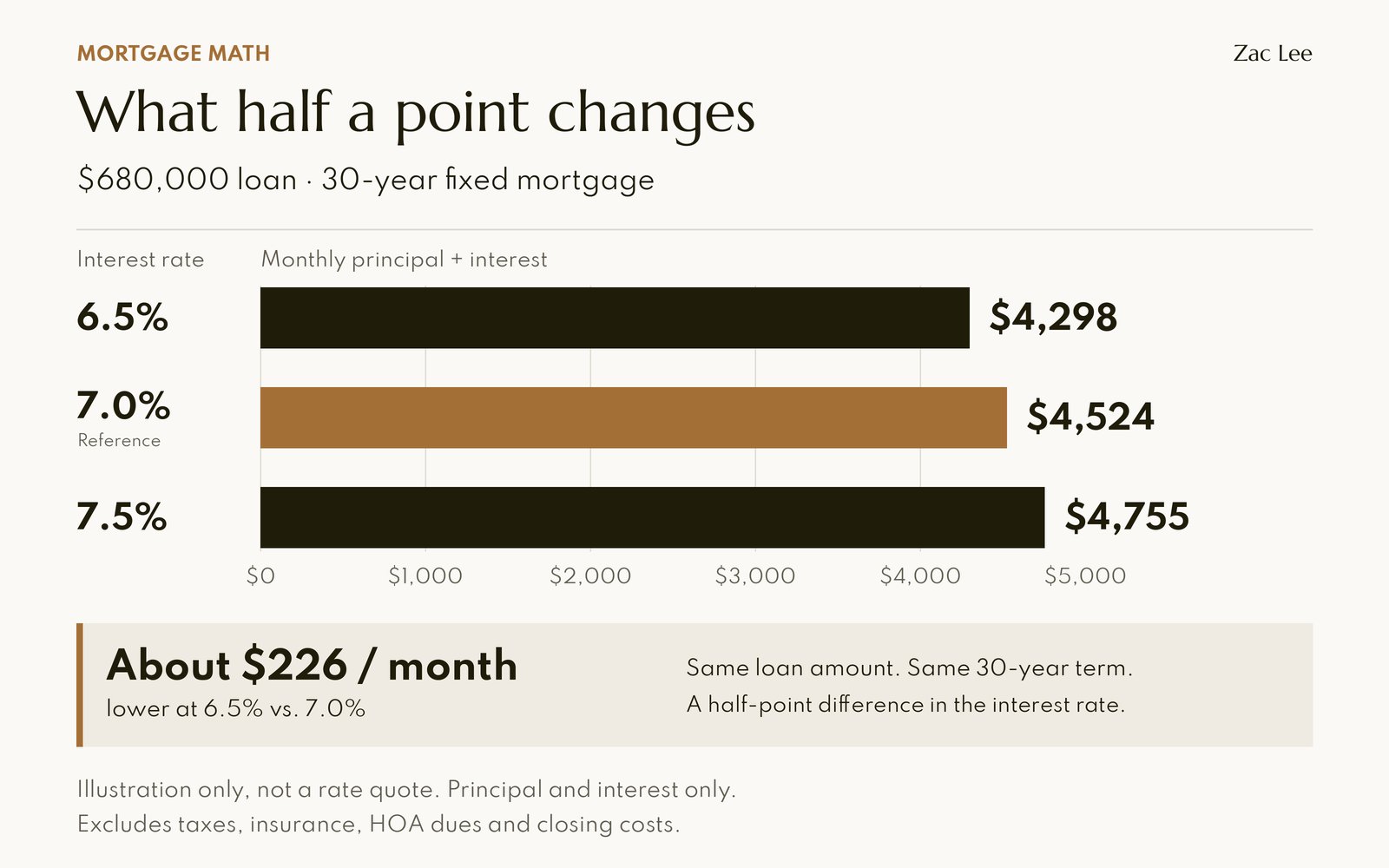
Illustrative monthly principal and interest on a $680,000, 30-year fixed mortgage
Interest rate | Monthly principal and interest |
6.5% | $4,298 |
7.0% | $4,524 |
7.5% | $4,755 |
Amounts are rounded to the nearest dollar. These payments cover principal and interest only. Property taxes, homeowners insurance, any mortgage insurance, HOA dues, and closing costs are additional. The illustration does not assume that a particular dollar amount of points will buy a particular rate reduction.
Compare the full monthly cost of the actual homes on your list. A condo, a townhome, and a detached house at the same purchase price can have quite different ownership costs. You can use my mortgage calculator as a starting point, then confirm the complete figures with your lender.
Compare seller credits with a price reduction
If a seller is open to negotiating, a price reduction is one option. A credit toward eligible closing costs is another. Depending on the loan program and its limits, that credit may help cover discount points or an approved temporary buydown.
A price reduction changes what you pay for the home. A closing-cost credit changes how certain purchase costs are covered. Ask your lender to put both options side by side, including the monthly payment and cash needed at closing, then work with your agent on the offer.
New-construction incentives need the same scrutiny. A builder’s advertised payment may depend on using a designated lender or meeting other conditions. Compare the complete offer with outside financing rather than assuming the incentive is the better deal.
Understand temporary versus permanent mortgage buydowns
A temporary buydown subsidizes payments for a limited period; it does not permanently lower the mortgage’s note rate. Paying discount points can lower the note rate on a fixed-rate loan. The upfront cost and actual rate reduction depend on the offer.
For a temporary buydown, have the lender show you every payment step and the full payment after the subsidy ends. The home needs to work for your budget at that full payment. A possible refinance later should not be what makes the purchase affordable.
Seattle mortgage budget questions
How do I estimate the break even period for discount points
For a simple estimate, divide the additional upfront cost by the monthly payment savings. The result is the number of months needed to recover that cost. Ask your lender to compare the total costs over the time you expect to keep the loan; selling or refinancing sooner can change the value of paying points.
Are seller credits and lender credits the same
No. Seller credits are negotiated in the purchase and applied to eligible costs, subject to loan-program limits. Lender credits come from the lender and commonly trade lower upfront costs for a higher interest rate. Ask how each credit affects the rate and cash to close.
Does a lower interest rate always mean a cheaper mortgage
No. A lower rate may come with higher upfront costs. Compare the rate, points, lender fees, mortgage insurance, and how long you expect to keep the loan before deciding which offer costs less for your plans.
Build the financing around the home and your plans
You don’t have to predict the next rate move to prepare well. Start with a payment you’re comfortable carrying, understand your loan options, and leave enough cash for life after closing.
My role is to help you evaluate the property and negotiate the purchase. Your lender can price the financing and explain the requirements. Working through those pieces together makes it easier to see which options genuinely help.
If you’re thinking about buying in Seattle or the surrounding area, reach out. We can talk through your priorities and what needs to be in place before you start making offers.